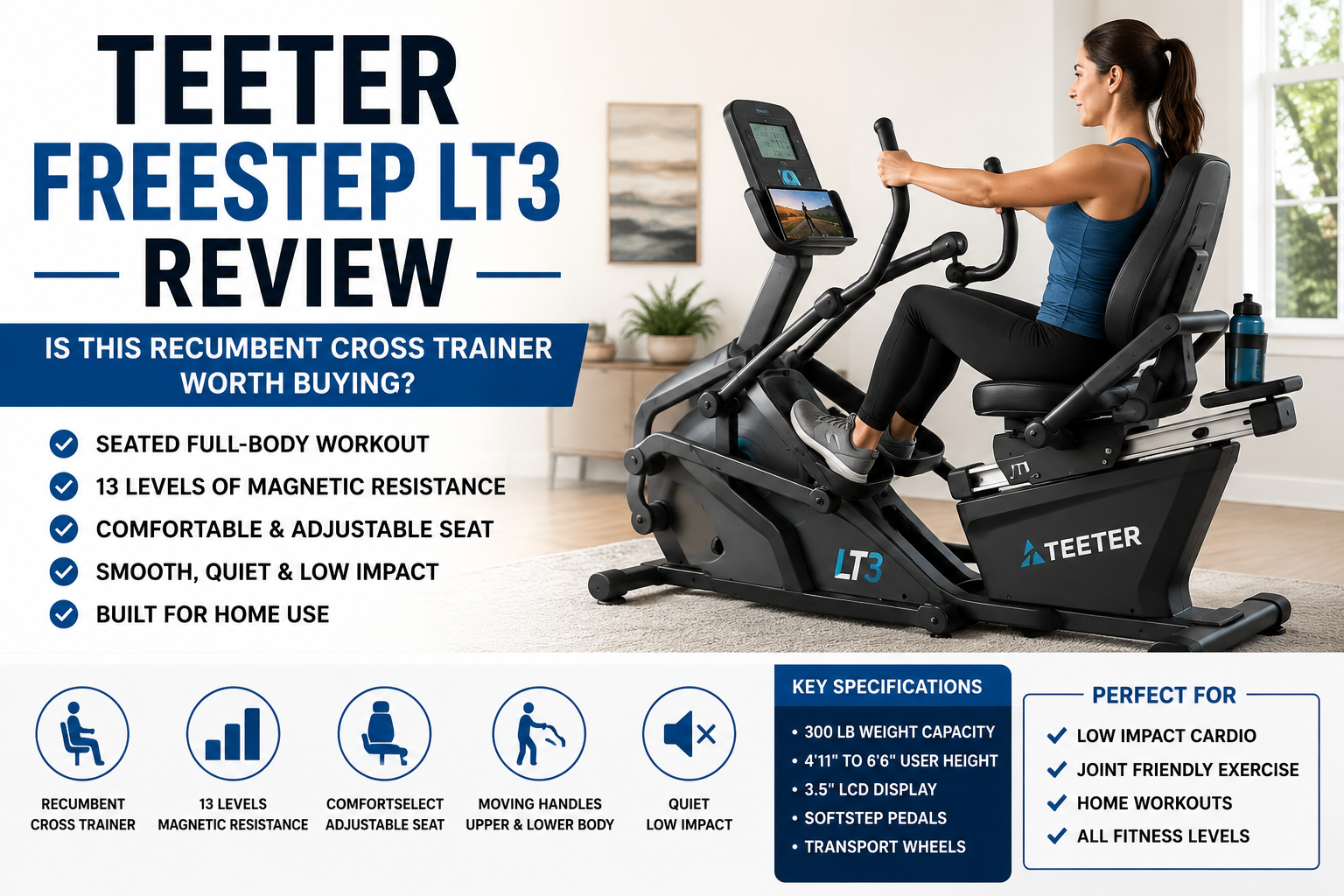
Teeter FreeStep LT3 Review: Is This Recumbent Cross Trainer Worth Buying?
Teeter FreeStep LT3 Review: The Teeter FreeStep LT3 is a seated recumbent cross trainer designed for home exercisers who want a full-body workout position that feels different from a traditional standing elliptical. Rather than standing on long elliptical pedals, you sit in an adjustable seat while moving the pedals and handles together, or you can focus on lower-body or upper-body movement during different sessions.
Disclosure: As an Amazon Associate, we earn from qualifying purchases. This Teeter FreeStep LT3 review is based on current published product specifications and comparison research. Product features, availability, warranty terms and prices may change, so verify the details of the exact listing before purchasing.
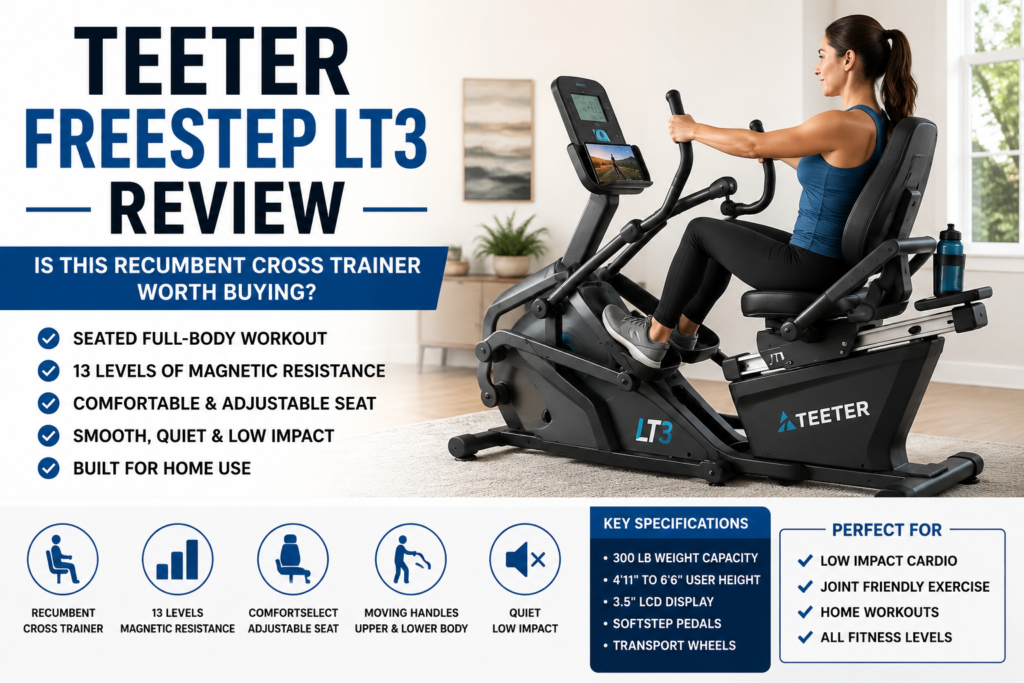
The FreeStep LT3 sits in a very different category from compact under-desk elliptical machines. It is a substantial home exercise machine weighing more than 110 pounds, with 13 levels of magnetic resistance, a 300-pound listed user capacity, adjustable seating, moving handles, a digital console, transport wheels and comfort upgrades over the lower-priced FreeStep LT1.
The main buying question is whether the seated cross-trainer design and comfort features justify its higher cost and larger footprint. In this Teeter FreeStep LT3 review, we examine its current specifications, important advantages, realistic drawbacks, ideal users and how it compares with traditional home ellipticals and compact seated exercise machines.
Teeter FreeStep LT3 Review: Quick Verdict
Best for: Home exercisers who prefer a seated cardio position and want upper- and lower-body movement in one substantial home machine.
Best feature: The recumbent design combines adjustable seating, moving handles, 13 magnetic resistance levels and comfort-focused LT3 upgrades.
Main drawback: The LT3 is large, heavy and considerably more expensive than an under-desk elliptical or basic compact exerciser.
Our verdict: The Teeter FreeStep LT3 is worth considering if you specifically want a seated cross trainer rather than a standing elliptical. Its adjustable seat, rubberized pedals, upgraded bearings and moving handles make it more comfort-focused than basic exercise machines. However, buyers who want a compact machine, a traditional elliptical stride or advanced digital workout technology may prefer another option.
View Current Teeter FreeStep LT3 Options on Amazon
As an Amazon Associate, we earn from qualifying purchases. Product prices and availability may change.
What Is the Teeter FreeStep LT3?
The Teeter FreeStep LT3 is a recumbent cross trainer intended for indoor home exercise. It uses a seated position combined with pedals and moving handles, allowing the user to perform a coordinated upper- and lower-body workout without standing on the machine.
Teeter describes the FreeStep line as using a natural stride design licensed from commercial physiotherapy steppers. From a buyer’s perspective, the important point is that this does not feel like a standard standing elliptical or a compact under-desk pedal machine. You sit in a supportive seat and move through a stepping-style motion while adjusting magnetic resistance to change workout intensity.
The LT3 is positioned between the more basic FreeStep LT1 and the higher-feature FreeStep LT7. Compared with the LT1, the LT3 adds premium comfort upgrades including UltraGlide steel ball bearings, SoftStep pedals, rubberized SureGrip handles and a larger ComfortSelect seat. Compared with the LT7, the LT3 has a simpler console, fewer resistance levels and a lower listed user-weight capacity.
If you are deciding between this seated design and a traditional standing elliptical, compare it with our Niceday Elliptical Machine Review or our Sole Fitness E95 Elliptical Machine Review. If you want something much smaller for seated movement, see our Under Desk Elliptical Exerciser Review.
Teeter FreeStep LT3 Specifications
The specifications below are based on the current Teeter FreeStep LT3 product information. Confirm current details, availability, pricing and warranty terms before purchasing.
| Specification | Teeter FreeStep LT3 Details |
|---|---|
| Product Type | Recumbent cross trainer for home use |
| Model | FreeStep LT3 / SE2301 |
| Exercise Position | Seated recumbent position |
| Resistance Type | Magnetic resistance |
| Resistance Levels | 13 levels, listed from 0 to 110 pounds of resistance |
| Flywheel | 7 pounds |
| Console | 3.5-inch LCD screen |
| Tracked Metrics | Time, speed, distance and estimated calories |
| Listed User Weight Capacity | 300 pounds |
| Listed User Height Range | 4 feet 11 inches to 6 feet 6 inches |
| Product Weight | 110.2 pounds |
| Assembled Dimensions | 62.1″L x 32.7″W x 55.4″H |
| Seat | ComfortSelect seat with larger surface area, two mounting positions, three-position recline and height adjustment |
| Handles | Four-position SureGrip rubberized handles |
| Pedals | SoftStep pedals with rubberized tread overlay |
| Additional Features | Media rack, water bottle holder, transport wheels and Teeter Move app access |
| Warranty Currently Listed by Teeter | 3-year frame / 2-year mechanical parts |
Important: Teeter offers multiple FreeStep models, including the LT1, LT3 and LT7. Make sure the listing you select is specifically for the LT3 if you want the comfort and feature upgrades described in this review.
Who Is the Teeter FreeStep LT3 Best For?
The Teeter FreeStep LT3 is intended for shoppers who want a dedicated home exercise machine but prefer to work out from a seated position. It is not a small portable pedal machine and it is not a traditional standing elliptical. Its value comes from combining a substantial frame, adjustable seating, magnetic resistance and upper- and lower-body movement.
The Teeter FreeStep LT3 May Be a Good Fit For:
- Home exercisers who prefer seated cardio: The recumbent seating position may feel more comfortable than standing throughout a workout.
- People who want upper- and lower-body movement: The pedals and moving handles allow the user to involve both arms and legs.
- Buyers who value adjustability: Seat height, seat recline and handle positions can be adjusted to suit different users and workout styles.
- People who want quiet magnetic resistance: A magnetic resistance system can be practical for home exercise spaces where noise matters.
- Buyers wanting a substantial home machine: At more than 110 pounds, this is a more permanent piece of equipment than a portable under-desk exerciser.
- Users who want comfort upgrades over the LT1: The LT3 includes upgraded pedals, bearings, handles and seating features.
The Teeter FreeStep LT3 May Not Be the Best Fit For:
- People with limited workout space: Its assembled footprint is far larger than an under-desk elliptical.
- Buyers who need an easily portable machine: Although it includes transport wheels, the LT3 weighs more than 110 pounds.
- Shoppers wanting a traditional standing elliptical stride: Its seated stepping motion is a different exercise experience.
- People wanting advanced digital features: The LT3 uses a basic 3.5-inch LCD rather than the larger technology package offered on the LT7.
- Users above the listed capacity: Teeter lists the LT3 maximum user weight at 300 pounds.
- Budget-focused shoppers: A compact under-desk machine may cost considerably less, although it offers a much different workout.
Teeter FreeStep LT3 Features
Recumbent Seated Cross-Trainer Design
The most important feature of the FreeStep LT3 is its seated cross-trainer design. Instead of balancing on standing elliptical pedals, the user sits in an adjustable seat while operating the pedals and handles.
This design changes both the feel and purpose of the machine. A standing elliptical is typically chosen for a more traditional upright cardio workout. An under-desk elliptical is designed for compact seated movement while working or relaxing. The FreeStep LT3 is intended for dedicated workouts from a seated position, with a much larger frame and more complete upper- and lower-body movement than an under-desk exerciser.
That makes the LT3 appealing for shoppers who want a home cardio machine but do not necessarily want to stand through the entire session.
13 Levels of Magnetic Resistance
The FreeStep LT3 includes 13 levels of magnetic resistance, which Teeter lists as ranging from 0 to 110 pounds of resistance. The adjustment is controlled through a dial, allowing the user to increase or decrease workout difficulty.
Lower resistance settings may be useful when becoming familiar with the machine or completing a longer steady session. Higher resistance settings can make the stepping and handle movement more demanding.
The official user guide states that the FreeStep ships set at its highest resistance setting and instructs users to dial resistance down before beginning. That is a useful setup detail for first-time buyers.
Dual Upper- and Lower-Body Motion
The FreeStep LT3 includes moving handles and pedals, giving users the option to engage their arms and legs together during a workout. The official user guide also describes standard full-body use, legs-only use and arms-only use configurations.
This versatility is a meaningful difference from both a basic recumbent bike and an under-desk elliptical. A compact seated pedal exerciser generally focuses on leg movement. The LT3 is designed to give users more ways to structure a dedicated workout session.
ComfortSelect Adjustable Seat
The LT3 includes Teeter’s ComfortSelect seat, which the company describes as having a larger seating surface than the LT1, two mounting positions, three recline positions and height adjustment.
Seat adjustment matters because a recumbent machine needs to fit the user’s body position comfortably. The official instructions state that the seat should be adjusted so that the knees maintain a slight bend when the leg is extended through the pedal motion.
For households where more than one person may use the machine, the available seating adjustments can also make it easier to switch between users with different heights and preferred seating positions.
SoftStep Pedals
The LT3 includes SoftStep pedals with a rubberized tread overlay. These pedals are one of the upgrades separating the LT3 from the lower-priced LT1 model.
For a seated cross trainer, pedal traction and comfort matter because your feet remain positioned on the pedals throughout the workout. The rubberized surface is intended to provide better grip and a more comfortable contact point during repeated use.
UltraGlide Bearings
Another LT3-specific upgrade is its UltraGlide steel ball bearings. Teeter describes these bearings as helping provide smoother motion at pivot points and smoother stride transitions.
This feature is difficult to evaluate from specifications alone, but it is relevant when comparing the LT3 with the LT1. Buyers paying more for the LT3 are primarily paying for comfort and motion upgrades rather than a completely different resistance or console system.
Four-Position SureGrip Handles
The FreeStep LT3 includes four-position rubberized SureGrip handles. Changing handle position can help users vary their grip or change how the upper-body portion of the movement feels.
The handle design is another practical distinction between a seated cross trainer and a compact seated pedal machine. On the LT3, arm involvement is part of the product’s primary purpose rather than an optional afterthought.
3.5-Inch LCD Console
The LT3 includes a 3.5-inch LCD console that tracks time, speed, distance and estimated calories. It also includes a media rack, allowing users to position a phone or tablet nearby during exercise.
This is a functional rather than premium technology package. It may be enough for shoppers who want simple workout feedback while watching their own entertainment or following an exercise routine. Buyers who want a larger built-in screen, more tracked metrics or more advanced controls may want to compare the higher-tier FreeStep LT7.
Transport Wheels and Water Bottle Holder
The LT3 includes rear transport wheels and an integrated water bottle holder. The wheels may help when repositioning the machine within a room, but buyers should remain realistic about portability: at 110.2 pounds, the LT3 is still a substantial piece of home exercise equipment.
This is a machine best suited to a dedicated exercise space or a location where it can remain set up most of the time.
Best Reason to Consider the Teeter FreeStep LT3
The strongest reason to consider the Teeter FreeStep LT3 is that it offers a dedicated seated workout with both arm and leg movement, while including comfort upgrades not found on the basic LT1 model. Its adjustable seat, upgraded pedals, rubberized handles and smoother-bearing design are intended for shoppers who expect to use a seated home cardio machine regularly.
It makes the most sense for buyers who specifically want a recumbent cross trainer rather than a standing elliptical or small under-desk pedal device.
Compare Current Teeter FreeStep LT3 Listings
As an Amazon Associate, we earn from qualifying purchases. Verify that the selected listing is for the LT3 model.
Teeter FreeStep LT3 Pros and Cons
Pros
- Seated recumbent cross-trainer design
- Allows coordinated upper- and lower-body movement
- 13 levels of magnetic resistance
- ComfortSelect seat with recline and height adjustment
- SoftStep rubberized pedals
- UltraGlide steel ball bearings
- Four-position SureGrip rubberized handles
- 3.5-inch LCD console with basic workout tracking
- Media rack, water bottle holder and transport wheels
- Listed height range accommodates users from 4’11” to 6’6″
- Current Teeter listing shows a 3-year frame / 2-year mechanical-parts warranty
Cons
- Large footprint compared with an under-desk elliptical
- 110.2-pound machine weight makes it difficult to move frequently
- 300-pound listed maximum user weight may exclude some shoppers
- Basic LCD console lacks the more advanced technology of the LT7
- Seated stepping motion will not appeal to buyers wanting a traditional elliptical feel
- Higher cost than compact seated pedal machines
- Requires assembly and a suitable dedicated home exercise area
Teeter FreeStep LT3 vs. LT1 vs. LT7
Teeter currently offers multiple FreeStep cross-trainer models. The LT3 is positioned as the comfort-upgraded middle option: more refined than the LT1, but without the larger console, increased resistance range and higher listed user capacity of the LT7.
| Comparison | FreeStep LT1 | FreeStep LT3 | FreeStep LT7 |
|---|---|---|---|
| Position in Lineup | Essential model | Comfort-upgraded model | Premium technology model |
| Resistance Levels | 13 levels | 13 levels | 20 levels |
| Console | 3.5-inch LCD | 3.5-inch LCD | 9-inch color LCD |
| Listed Weight Capacity | 300 pounds | 300 pounds | 350 pounds |
| Pedals | Large grip surface with edge guards | SoftStep rubberized tread overlay | SoftStep rubberized tread overlay |
| Handles | Four-position foam grip | Four-position rubberized SureGrip | Rubberized SureGrip with micro-adjust feature |
| Best For | Lower-cost entry into FreeStep design | Buyers wanting comfort upgrades without LT7 technology | Buyers wanting upgraded console, resistance and capacity |
Choose the LT3 if you value upgraded comfort features over the LT1 but do not need the larger screen and increased resistance range of the LT7. Choose the LT1 if cost matters more than upgraded pedals and bearings. Choose the LT7 if you want the most advanced FreeStep console and higher listed weight capacity.
Teeter FreeStep LT3 vs. a Traditional Elliptical Machine
The FreeStep LT3 is sometimes grouped with ellipticals because it provides low-impact cardio movement, but it should not be confused with a standard upright elliptical trainer. The exercise position and motion are different.
| Comparison | Teeter FreeStep LT3 | Traditional Home Elliptical |
|---|---|---|
| Exercise Position | Seated / recumbent | Standing |
| Movement Style | Seated stepping motion with handles | Standing elliptical stride with handles |
| Main Appeal | Dedicated seated full-body workout | Traditional upright cardio workout |
| Space Required | Large dedicated footprint | Also requires dedicated floor space |
| Who May Prefer It | Buyers who prefer exercising while seated | Buyers who prefer standing workouts |
If you want a standard standing elliptical, compare the FreeStep LT3 with a home model such as the Niceday Elliptical Machine or a more premium alternative such as the Sole Fitness E95.
Teeter FreeStep LT3 vs. an Under Desk Elliptical
The FreeStep LT3 and an under-desk elliptical are both seated exercise options, but they serve very different purposes. A compact under-desk machine is designed for light movement while you sit at a desk or relax in a chair. The LT3 is designed as a dedicated home workout machine with a seat, handles, adjustable resistance and a much larger frame.
| Comparison | Teeter FreeStep LT3 | Under Desk Elliptical |
|---|---|---|
| Primary Use | Dedicated seated workouts | Movement while already seated |
| Upper-Body Motion | Moving handles included | Usually none |
| Size | Large home exercise machine | Compact pedal machine |
| Storage | Best kept in a dedicated location | Easier to move and store |
| Best For | People wanting seated full-body exercise | People wanting compact seated leg movement |
If your priority is a small seated machine for desk or television time, read our Under Desk Elliptical Exerciser Review or our MERACH Under Desk Elliptical Machine Review.
What to Consider Before Buying the Teeter FreeStep LT3
Make Sure You Want a Seated Workout Position
The LT3 is not simply a traditional elliptical with a chair added. Its seated recumbent design creates a different workout position and motion. That may be the reason you love it, or it may be the reason another machine makes more sense.
If you prefer exercising while seated and still want moving handles, resistance adjustment and a dedicated workout machine, the FreeStep LT3 deserves consideration. If you prefer an upright gym-style stride, compare standing elliptical models before buying.
Measure the Space Carefully
The LT3 is not compact. Teeter currently lists its assembled dimensions as 62.1 inches long by 32.7 inches wide by 55.4 inches high. It also weighs 110.2 pounds.
Before purchasing, measure your intended exercise area and allow room to get on and off the machine comfortably. While rear transport wheels can help reposition it, this is not exercise equipment most buyers will want to move in and out of storage every day.
Check the Weight and Height Limits
Teeter lists the FreeStep LT3 for users from 4 feet 11 inches through 6 feet 6 inches, with a maximum listed user weight of 300 pounds. Buyers outside those specifications should not assume the machine will be appropriate.
If you need a higher listed user capacity within the FreeStep line, the current LT7 listing shows a 350-pound capacity and should be compared separately.
Decide Whether the Console Is Enough
The LT3 includes a basic 3.5-inch LCD that tracks four metrics: time, speed, distance and estimated calories. It also has a media rack for your own phone or tablet.
This setup may be perfectly adequate for buyers who exercise while watching their own content or following a simple routine. It may feel limited for buyers who want a large built-in display, extensive metrics or more advanced digital features. Those shoppers should compare the FreeStep LT7 or other technology-focused equipment.
Understand What You Are Paying Extra for Over the LT1
The LT1 and LT3 share several core characteristics, including 13 resistance levels, a 3.5-inch LCD, a 300-pound listed capacity and a similar basic cross-trainer design.
The reason to pay more for the LT3 is its comfort-focused upgrades: SoftStep pedals, UltraGlide bearings, rubberized SureGrip handles and the enhanced ComfortSelect seat. If those upgrades matter to you because you plan to use the machine consistently, the LT3 may be the better value. If they do not, compare the LT1 before purchasing.
Do Not Treat It as Medical Equipment
The seated design may appeal to people looking for a more comfortable way to exercise, and Teeter markets its motion around low-impact benefits. However, this is a consumer home exercise machine, not a medical treatment plan.
If you are purchasing equipment because of an injury, surgery, balance concern, joint issue or health condition, speak with an appropriate medical professional before beginning a new exercise routine.
Check Current Teeter FreeStep LT3 Availability
How to Use the Teeter FreeStep LT3
The FreeStep LT3 is designed for indoor home use on a stable, level surface. Read the included user guide before first use, complete assembly carefully and verify that all adjustable components are secured before beginning a workout.
- Place the machine on a stable level floor with enough room around the seat, pedals and handles.
- Adjust the seat height so your knee remains slightly bent when your leg is near full extension.
- Adjust the seat recline and handle positions to a comfortable setup before exercising.
- Begin with a low resistance setting while becoming familiar with the motion.
- Use both arms and legs together for a balanced full-body session, or adjust your use pattern according to the manufacturer instructions.
- Monitor your session using the LCD console or a device placed on the media rack.
- Slow pedal motion gradually before finishing your workout.
Safety note: Teeter’s official user guide states that the pedals may continue to spin when you stop pedaling, that users should reduce pedal speed in a controlled manner, and that the machine is intended for indoor consumer home use only.
Frequently Asked Questions
Is the Teeter FreeStep LT3 a Traditional Elliptical?
No. The FreeStep LT3 is a seated recumbent cross trainer. It uses pedals and moving handles, but its seated stepping motion differs from the upright stride of a standard elliptical trainer.
How Many Resistance Levels Does the Teeter FreeStep LT3 Have?
The current Teeter specifications list 13 levels of magnetic resistance, ranging from 0 to 110 pounds of resistance.
What Is the Weight Capacity of the Teeter FreeStep LT3?
Teeter currently lists the LT3 with a maximum user weight capacity of 300 pounds.
What User Heights Does the FreeStep LT3 Accommodate?
The current official specifications list a user-height range of 4 feet 11 inches through 6 feet 6 inches.
How Much Does the Teeter FreeStep LT3 Weigh?
The LT3 is currently listed at 110.2 pounds. It includes transport wheels, but buyers should plan on keeping it in a dedicated exercise area rather than carrying it regularly.
What Does the Console Track?
The 3.5-inch LCD console tracks time, speed, distance and estimated calories. It also includes a media rack for positioning a phone or tablet.
What Is the Difference Between the Teeter FreeStep LT1 and LT3?
The LT3 adds comfort-focused upgrades including UltraGlide steel ball bearings, SoftStep rubberized pedals, SureGrip rubberized handles and a ComfortSelect seat with a larger surface area and additional mounting flexibility.
What Is the Difference Between the LT3 and LT7?
The LT7 is the higher-feature model. Teeter currently lists it with 20 levels of magnetic resistance, a 9-inch color LCD screen, more tracked metrics, a heavier flywheel and a higher 350-pound listed user capacity. The LT3 is the simpler comfort-upgraded option.
Is the Teeter FreeStep LT3 Better Than an Under Desk Elliptical?
They are designed for different purposes. The LT3 is a dedicated seated full-body home workout machine with handles and resistance settings. An under-desk elliptical is much smaller and is generally intended for light seated leg movement while working or relaxing.
Is the Teeter FreeStep LT3 Worth the Money?
It may be worth the price for buyers who specifically want a seated cross trainer, have enough room for a dedicated home machine and value the LT3 comfort upgrades. Buyers who only want compact seated movement or a traditional standing elliptical should compare alternatives first.
Teeter FreeStep LT3 Review: Final Verdict
The Teeter FreeStep LT3 is a substantial seated cross trainer for buyers who want more than an under-desk pedal machine but prefer not to use a traditional standing elliptical. Its adjustable recumbent seat, moving handles, magnetic resistance, SoftStep pedals and UltraGlide bearings create a comfort-focused home exercise option with both upper- and lower-body movement.
The LT3’s biggest strengths are its seated design, adjustment options and comfort upgrades over the LT1. Its biggest drawbacks are its size, weight, price category and relatively basic console compared with the higher-end LT7.
Buy the Teeter FreeStep LT3 if you want a dedicated seated cross trainer, have room for a 110-pound exercise machine and value the LT3 comfort upgrades. Consider another option if you want compact seated movement, a standing elliptical stride, a higher user-weight capacity or advanced console features.
Compare Current Teeter FreeStep LT3 Listings
Teeter offers multiple FreeStep models, so verify that the product listing you choose is specifically for the LT3 and includes the comfort features, resistance levels, capacity and warranty terms you expect.
View Teeter FreeStep LT3 Options on Amazon
As an Amazon Associate, we earn from qualifying purchases. Prices, product listings and availability may change.
Related Elliptical Reviews
- Niceday Elliptical Machine Review
- Sole Fitness E95 Elliptical Machine Review
- YOSUDA Pro Cardio Climber Review
- Under Desk Elliptical Exerciser Review
- MERACH Under Desk Elliptical Machine Review